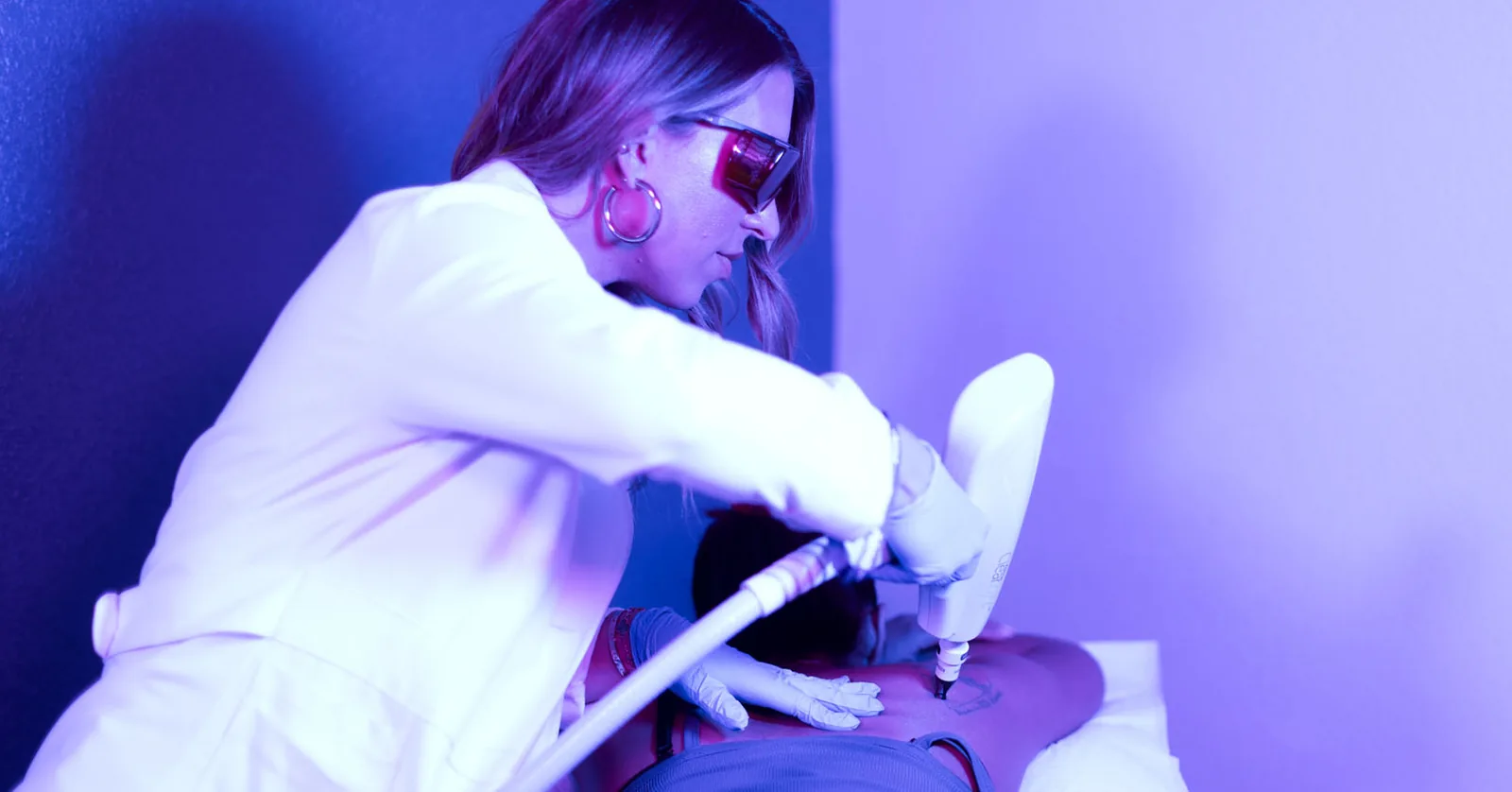
If a tattoo no longer fits your life, the first questions are usually practical: can it be faded or removed in El Paso, and how many laser sessions will it take? This guide explains how laser tattoo removal works at ADI MedSpa, what typically shapes the session plan, and what to expect at a complimentary consultation. Results vary, and a provider has to decide whether treatment is right for you.
How laser tattoo removal works in El Paso
ADI MedSpa offers laser tattoo removal in El Paso with ClearLift Pro, a Q-Switch Nd:YAG applicator on the Alma Harmony platform. It delivers intense nanosecond pulses that target tattoo ink, which then fades gradually as your body clears the particles. Every plan is physician-directed and built around your tattoo and your skin.
The laser shatters the ink into smaller particles, and your immune system clears them over time. That is why fading happens session by session rather than all at once, and why results depend on the ink, its depth and density, the colors, the location and your skin.
At ADI MedSpa, Dr. Farooque Ahmed, MD reviews every treatment plan. Our nurse practitioners deliver your care under full physician oversight, and they will take time to explain what is realistic before you start. ADI MedSpa was named to Best of El Paso's Top 5 for Tattoo Removal. That recognition is not a promise about any one tattoo; your plan is still built around your ink, your skin and honest expectations.
If you want more device context, you can also see the Alma Harmony platform and our technology pages. Tattoo removal sits with our other skin and laser treatments.
How many sessions for laser tattoo removal?
Laser tattoo removal takes a series of sessions, and the number you need depends on your tattoo and your skin. Authoritative sources often cite about five to ten visits as typical, though some tattoos need more, and complete clearing is not guaranteed. ADI MedSpa will not promise a number before a consultation.
A June 2015 FDA Cosmetic Facts sheet says it may take 6 to 10 treatments to remove a tattoo. The FDA's current consumer update does not repeat that number; it says laser tattoo removal requires multiple treatments, with a few weeks in between, and that complete removal can take many treatments and is not always possible. UCSF Health similarly says some people finish in five to 10 sessions, while many need additional visits — up to 20 in some cases. The count can also change with the amount of ink, the age of the tattoo and whether the ink has been layered. Dense, colorful or newer tattoos often take longer.
Your provider will look at your tattoo and your skin in person and map a plan with honest expectations from the start.
Does it work on colored ink, darker skin or cosmetic tattoos?
Black and dark-blue ink usually fade more readily than red, green or yellow, and not every color clears completely. Darker skin can be treated, but the risk of pigment change is higher, so the plan has to fit the tattoo and the skin. Cosmetic or eyebrow ink needs an in-person review first.
Different ink colors absorb different wavelengths of light, so multi-colored tattoos can fade more slowly and may not clear evenly. Bright, multi-colored work is often the hardest to remove. Your provider will look at the actual colors in your tattoo and tell you what is realistic.
A Q-switched Nd:YAG laser is often used on darker skin to help reduce the chance of a lasting pigment change. That does not make treatment risk-free. Darker skin still carries a higher risk of the treated area becoming lighter or darker than the skin around it, so candidacy and settings are decided in person.
Cosmetic tattoos and eyebrow ink are a special case. Permanent makeup, flesh-toned ink and white ink can sometimes darken, or oxidize, when they are treated with a laser. That is why these tattoos need a careful evaluation, and why treatment is not automatic.
Does laser tattoo removal hurt, and what should I expect after?
The sensation is often compared to a rubber-band snap against the skin. Sessions are usually spaced several weeks apart so your skin can heal and your body can clear ink. After a visit, redness, swelling and some blistering can occur, and scarring or pigment change is possible. Your provider will review risks, timing and aftercare.
The FDA uses that comparison and notes that a numbing cream can be applied if the procedure is painful. That is general guidance, not a description of what ADI MedSpa offers. Comfort options, if they are appropriate for you, are something to ask about at your consultation. We don't describe the treatment as painless.
Spacing also varies. Sources such as UCSF Health often describe a typical interval of six to eight weeks. The FDA simply notes that sessions are spaced a few weeks apart so the skin can heal. Your provider will set the timing for your plan rather than using a one-size-fits-all calendar.
Some people also notice pinpoint bleeding or soreness. The treated skin may become lighter or darker than the skin around it; the American Academy of Dermatology notes that these spots tend to disappear within 6 to 12 months, though pigment change can last. Scarring is uncommon when treatment is appropriately performed, but it is not impossible. Follow the aftercare your provider gives you: keep the area clean, protect it while it heals, and keep it out of the sun as directed. Dermatologists often advise protecting treated skin from the sun for about three months.
Not everyone is a candidate. A provider reviews your health history first. People who are pregnant or breastfeeding, or who do not have a healthy immune system, are generally not treated.
Can a tattoo be removed completely?
Complete removal is not guaranteed. Many tattoos fade a great deal over a series of sessions, but some ink can remain, and a faint shadow or outline is possible. Results vary with ink color, density, location and skin, and a provider has to decide whether treatment is appropriate for you.
The most common limitation is incomplete fading, even after a full series of visits. We can tell you what is likely only after we see your tattoo.
What happens at a complimentary consultation
The first step is a complimentary consultation with one of our providers. They'll look at your tattoo and your skin, explain what laser tattoo removal can and cannot do, and talk through risks and a realistic session plan. If treatment is a good fit, you'll leave with next steps tailored to your tattoo.
Expect a private, unhurried visit and no pressure. This is also when candidacy is decided. If treatment is not right for you, we will say so.
Ready when you are: book your complimentary consultation online or call (915) 474-3239. We're at 11331 James Watt Rd, Bldg. 100, El Paso, TX 79936, Monday–Friday, 8 a.m. to 5 p.m. If you are also exploring other laser or aesthetic care, you can browse all services.
Frequently asked questions
How many sessions will I need?
It varies. A typical course is often described as about five to 10 sessions, and some tattoos need more. The number depends on your ink, its colors and density, the location, and your skin. ADI MedSpa will not promise a session count before a consultation, when your provider can map a plan.
Does laser tattoo removal hurt?
It can be uncomfortable. The sensation is often compared to a rubber-band snap against the skin. Comfort options, if they are appropriate for you, can be discussed at your consultation. The treatment is not painless.
Does it work on colored ink (red, green, yellow, blue) as well as black?
It can, but results are not equal across colors. Black and dark blue are usually the most responsive. Red, green and yellow are often harder to fade, and multi-colored tattoos may not clear evenly or completely. Your provider will review the colors in your tattoo in person.
Can a tattoo be removed completely, or only faded?
Complete removal is not guaranteed. Many tattoos fade substantially, but some ink may remain, and a faint shadow is possible. Results vary, and it is not possible to predict with certainty which tattoos will clear completely.
How far apart are sessions, and what is aftercare?
Sessions are usually spaced several weeks apart — often six to eight weeks in published clinical guidance — so your skin can heal and your body can clear ink. Your provider will set the interval for your plan and give you aftercare instructions. In general, keep the area clean, protect it while it heals, and follow sun-protection guidance.
Is it safe for darker skin tones?
It can be, when a provider evaluates your skin and plans treatment around both the tattoo and your skin type. Darker skin has a higher risk of pigment change. A Q-switched Nd:YAG laser is often used on darker skin for this reason, which is the type of laser ADI MedSpa uses. Candidacy is still decided in person.
Can cosmetic tattoos or eyebrow ink be treated?
Sometimes, but not automatically. Cosmetic tattoos, eyebrow ink and other permanent makeup need a careful in-person evaluation, because some pigments can darken when treated with a laser. A provider has to decide whether treatment is appropriate for that ink.
Will it scar, or leave a shadow?
A residual shadow or some remaining ink is possible, and incomplete fading is the most common limitation. Scarring is uncommon when treatment is appropriately performed, but it is not impossible. Other possible effects include redness, swelling, blistering, soreness and temporary or lasting pigment change.
Ready to talk through your tattoo? Book a complimentary consultation with our physician-led team in El Paso, or call (915) 474-3239.
Sources
- ADI MedSpa laser tattoo removal (ClearLift Pro, Q-Switch Nd:YAG on Alma Harmony, nanosecond pulses, session-by-session fading, physician-directed care, complimentary consultation, location and hours, Best of El Paso's Top 5 for Tattoo Removal): https://adimedspa.com/laser-tattoo-removal/
- Alma Harmony platform context: https://adimedspa.com/harmony-xl-pro/
- FDA, June 2015 Cosmetic Facts sheet (6 to 10 treatments; darker colors easier than yellow, green, and red; complete removal not guaranteed): https://www.fda.gov/media/93379/download
- FDA, current consumer update (multiple treatments with a few weeks in between; complete removal can take many treatments and may not be possible; rubber-band sensation; numbing cream as general guidance; color response; permanent makeup can oxidize): https://www.fda.gov/consumers/consumer-updates/tattoo-removal-options-and-results and https://www.fda.gov/consumers/womens-health-topics/tattoos-and-permanent-make
- UCSF Health, typical 5–10 sessions, some need up to 20, six-to-eight-week spacing, incomplete removal: https://www.ucsfhealth.org/care/treatments/laser-tattoo-removal
- American Academy of Dermatology, why multiple sessions are needed, aftercare, side effects, pregnancy/breastfeeding and immune-system candidacy limits: https://www.aad.org/public/cosmetic/hair-removal/laser-tattoo-removal
- Mayo Clinic, Q-switched Nd:YAG on darker skin, repeated sessions, complete removal not always possible: https://www.mayoclinic.org/tests-procedures/tattoo-removal/about/pac-20395105
This guide is general information, not medical advice. Talk with a qualified provider about your health history and goals before starting any treatment.